
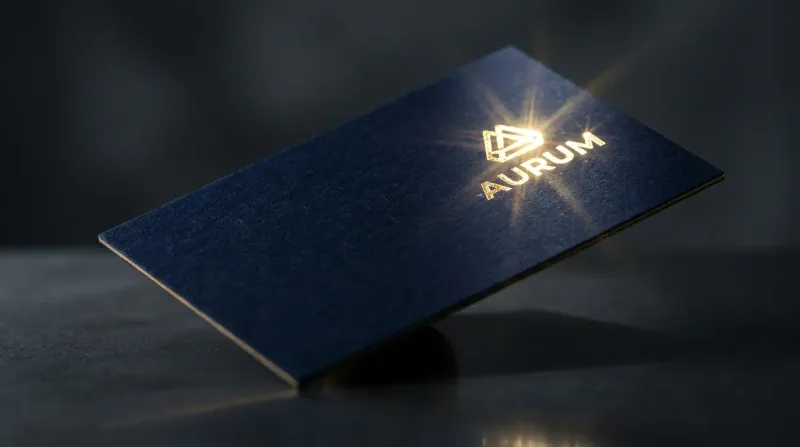
Two business cards can be printed on the exact same paper, in the exact same colors, and still feel completely different in someone's hand. The difference is almost always finishing — the extra step after printing that changes how a piece looks, feels, and holds up. It's also one of the most confusing parts of ordering print, because the names don't explain themselves. Here's what each one actually does, and when it's worth it.
Foil Stamping
Foil applies a thin layer of metallic (or occasionally matte-colored) film to specific parts of a design — usually a logo, a name, or a border. It catches light and reflects, which is why it reads as "premium" almost instantly; nothing else in print does what foil does under light.
Best for: logos, initials, or short text you want to feel expensive — law firms, real estate, luxury or high-end retail, wedding invitations. Foil works best on small, deliberate accents rather than covering a whole design; it's a spotlight, not a paint job.
Spot UV
Spot UV applies a glossy, raised coating to specific areas of a design while the rest of the piece stays matte. The effect is subtle in photos but obvious in hand — you can see and feel exactly where the coating is, which creates contrast and texture without adding color.
Best for: highlighting a logo, an icon, or a headline on an otherwise matte piece. It's a quieter effect than foil, which makes it a good fit for brands that want "premium" without looking flashy.
Soft Touch Lamination
Soft touch (sometimes called soft-touch or velvet lamination) is a laminate finish that makes a piece feel almost like suede — smooth, slightly textured, and noticeably different from a standard glossy or matte card the moment someone picks it up.
Best for: anything meant to be handled and remembered — business cards especially. It's one of the most common "why does this card feel so different" finishes, and it's durable, resisting fingerprints and smudging better than plain matte stock.
Die Cutting
Die cutting uses a custom-shaped blade to cut a printed piece into something other than a standard rectangle — rounded corners, a custom silhouette, a cutout window, or an entirely unique shape.
Best for: anything that needs to stand out physically, not just visually — a rounded-corner business card that feels different in a stack of square ones, a custom-shaped hang tag, a folder with a die-cut window showing what's inside.
Which One Should You Pick?
There's no single "best" finish — it depends on what the piece needs to do:
- Want something that catches the eye across a room? Foil.
- Want subtle texture that rewards a closer look? Spot UV.
- Want something that feels premium in someone's hand? Soft touch.
- Want a shape nobody else has? Die cut.
They can also be combined — a soft touch card with a foil logo is a common, effective pairing that layers texture and shine without overdoing either one.
Let's Talk Finishes
If you're not sure which finish fits your project, that's exactly the kind of thing worth a quick conversation before you order — the right finish can make a modest design feel significant, and the wrong one can bury a great design in an effect it didn't need.
Request a free quote today, or call Rex directly at (866) 407-7468.